
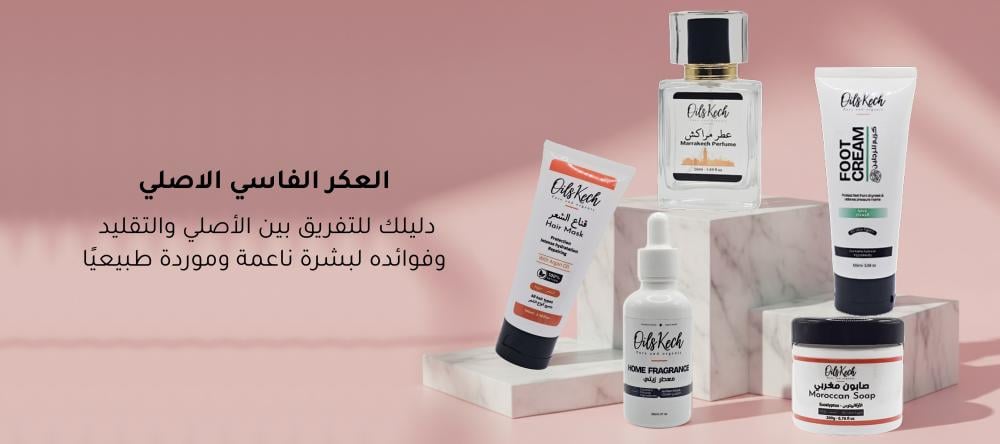
How many times have you bought a product described as authentic Aker Fassi only to be disappointed? Authentic Aker Fassi is one of the most popular natural skincare ingredients in the Saudi market in recent years, but with its popularity came counterfeiting and adulteration. Many women tried it and saw no difference because they didn't get the real thing. In this article, you'll learn exactly what it is, how to distinguish between the genuine and the fake, and how to use it correctly to achieve the real results that Moroccan women have been talking about for generations.
Many women seek genuine skin lightening but are met with counterfeit products.
The original Aker Fassi has become so widely known in Saudi Arabia that its name is now found in almost every household, but the genuine product itself is only accessible to a minority. The problem isn't with the ingredient itself, but with what's being sold under its name. Many similar products appear in markets and online stores, but their benefits are nowhere near those of genuine Aker Fassi.
Saudi women who care for their skin and seek natural products often find themselves faced with confusing choices, especially with the proliferation of social media content promoting products with attractive images but no real credibility. The result is financial loss and repeated disappointment, leading some to doubt the effectiveness of all natural ingredients.
The simple solution is to understand what authentic Aker Fassi really is, where it comes from, what it looks like, and what it smells like before you put your hand in your wallet.
What is the original Aker Fassi and why is it considered a special ingredient?
Original Aker Fassi is a rare natural clay extracted from the Fez region of Morocco. It is a type of clay rich in natural minerals such as silica, magnesium, calcium, and iron. What distinguishes it from ordinary clay is its unique ability to absorb excess oil and deeply cleanse pores while simultaneously preserving the skin's natural moisture—a balance rarely found in skincare ingredients.
Aker Fassi, in terms of origin and extraction
- The original Aker Fassi is extracted manually from layers of earth in specific areas around the city of Fez, then dried in the open air for months before being ground and packaged.
- This lengthy process is what gives it a high concentration of active minerals.
- The traditional imitation product is made from cheap clay or synthetic materials that mimic its brick-red color without any of its characteristics.
- Moroccan women have been using Aker Fassi for hundreds of years as part of their weekly bath ritual, and this practice has spread to the Saudi market, which now consumes large quantities of it annually as interest in natural care products grows.
Original and imitation Aker Fassi: How can you easily distinguish between them?
The difference between the original and imitation Aker Fassi can be detected by your senses without the need for any specialized expertise, but you need to know what you are looking for.
the color
The original Aker Fassi is brick red to medium reddish-brown in color, neither bright red nor dark brown. A very bright or perfectly uniform color is evidence of the addition of artificial dyes.
Texture
Genuine okra is very smooth to the touch, like coarse silk, without any rough grains or lumps. Imitations are often rough or contain irregular particles.
The smell
Authentic Aker Fassi has a light, natural, earthy scent, similar to the smell of the earth after rain. It has no chemical or strong odor. If it has a sharp or chemical smell, it is fake.
Water response
Genuine turbidity absorbs water quickly and turns into a smooth, homogeneous paste. Imitations either dissolve too quickly or remain lumpy and do not turn into a smooth paste.
Do you want a genuine, authentic Aker Fassi? Browse the natural care products at Oils Kitchen and make sure of the real quality before you buy.
What are the benefits of Aker Fassi for the skin, and why is it included in the skincare routine?
The benefits of Aker Fassi for the skin are well-documented through experience, even before any scientific research. However, recent studies are beginning to confirm what Moroccan women have known for generations. The clay, rich in silica, helps to regenerate skin cells and improve elasticity, while magnesium soothes skin inflammation and reduces redness in sensitive skin.
Deep cleaning and removal of dead cells:
The benefits of Aker Fassi begin with its ability to effectively absorb oil and impurities from deep within pores, surpassing most commercial cleansers. Its gentle exfoliation of dead skin cells leaves the skin noticeably soft and clear after the first use.
Brightening and unifying:
Aker Fassi does not chemically lighten the skin like products containing hydroquinone or mercury, but rather gradually improves its appearance by renewing skin cells and cleansing them of impurities that cause dark spots. The result is a more even and radiant complexion, not forced lightening.
Suitable for oily and combination skin:
Oily skin in the Saudi climate finds in Aker Fassi a natural solution that balances sebum production without excessive drying. Using it once or twice a week shows a noticeable difference in excess shine and the appearance of pores within two to three weeks.
Original Aker Fassi (red clay) for washing and soap: Multiple uses in daily care
Original Aker Fassi (a type of red clay) is most commonly used as a face wash and gives noticeable, immediate results. The correct method is to mix a small amount of Aker powder with lukewarm water until a medium-consistency paste is formed, then apply it to the face in gentle circular motions for one to two minutes before rinsing with cool water. The cool water at the end of the wash closes the pores and gives the skin an immediate glow.
Aker Fassi soap is a ready-to-use, everyday option for those who don't want to bother preparing the paste each time. Authentic Aker Fassi soap combines the benefits of Aker Fassi with the ease of daily use, requiring no preparation or measuring.
Using it as a mask
- Aker Fassi gives deeper results when left on the face for 10 to 15 minutes as a weekly mask.
- The important thing to pay attention to here is not to allow it to dry completely on the skin because that may cause painful pulling.
- When the dough starts to crack slightly, start rinsing immediately.
For the body in the bath
- Aker Fassi for the body is used after steaming or a hot shower when the pores are open, which doubles the effectiveness of the cleansing.
- This is the original Moroccan bath method that makes the skin remarkably soft after just one session.
Important tips before using Aker Fassi to get the best results
The benefits of Aker Fassi multiply when you use it correctly and disappear when you fall into the common mistakes that many people make at the beginning.
Do not mix it with hot water
Hot water reduces the effectiveness of minerals in removing turbidity. Lukewarm water is ideal for preparation, and cold water for the final rinse.
Do not rub too hard
Aker Fassi works by gentle application, not by vigorous rubbing. Excessive rubbing irritates the skin and can have the opposite effect on sensitive skin.
Start with once a week
Sensitive skin needs time to adjust to any new ingredient. Start with weekly use for a month, then increase the frequency if desired.
Always moisturize afterward.
Aker Fassi cleanses deeply, requiring immediate moisturizing after use to replenish any moisture it has taken from the skin. Argan oil is the perfect complement to this step in an authentic Moroccan skincare routine.
very dry skin
If your skin is very dry, add a few drops of almond or argan oil to the paste before applying it to your face. This preserves the benefits and prevents a tight feeling.
Have you tried skincare with authentic Moroccan products? Browse the OilsKitchen store and discover a range of guaranteed quality natural skincare products.
Frequently Asked Questions
How do I know if Aker Fassi is genuine?
Its color is a medium, muted brick red; its texture is silky smooth without any rough grains; and it has a light, natural, earthy aroma. When mixed with water, it quickly forms a smooth, homogeneous paste. Imitations have a perfectly uniform color, a chemical odor, or remain lumpy during preparation.
What is Aker Fassi and what are its benefits?
Aker Fassi is a natural clay extracted from the Fez region of Morocco, rich in silica, magnesium, and calcium. Its benefits for the skin include deep cleansing, absorption of excess oil, gentle exfoliation of dead skin cells, and improvement of skin appearance and even tone with regular use. Suitable for oily, combination, and normal skin.
What is the difference between the original and imitation Aker Fassi?
The original is extracted from the natural clay of Fez, with its natural brick-red color and rich mineral composition. Imitations are made of ordinary clay or synthetic materials that merely mimic the color without the active minerals. The difference is noticeable in the texture, scent, and hydration, and even more so in the results on the skin after regular use.
conclusion
Authentic Moroccan red clay (Aker Fassi) isn't just a trendy social media product; it's a genuine skincare ingredient with a long history and proven benefits, both empirically and scientifically. The problem has never been with the ingredient itself, but with what's sold under its name. Once you learn how to distinguish between the genuine and the counterfeit, and how to use it correctly, you'll understand why Moroccan women still rely on it after all these years.
Browse Oils Kitch now and get the authentic Aker Fassi your skin deserves